


Bull Sharks in Cancun: Where They Really Are, and What the Dive Is Actually Like

Actualizado: 19 ago
There is a stretch of beach at Playa del Carmen where people stand in the shallows with their children. About six hundred meters out, in eighty feet of water, fifteen bull sharks are cruising a patch of sand.
That is not an exaggeration for effect. The site is less than a kilometer from shore. From the boat, it is a five-minute ride. We have been running these dives for years, and it still gets us how close they are to a beach full of people who have no idea.
Swimmers might worry about the sharks, but in clear water, bull sharks are harmless and not a threat, which should reassure you.
The name is wrong, and we would rather say so
Everybody searches for bull sharks in Cancun. We rank for it, we sell the trip, and we are a Cancun dive shop. But the sharks are not in Cancun. They gather off Playa del Carmen, about an hour down the coast from our shop.
We run the trip from Cancun. You check in with us; we drive you down; you dive; we bring you back. This means bull sharks are not in Cancun, but about an hour south at Playa del Carmen, and we want you to know this upfront to avoid confusion. Bull sharks in Cancun is a fair description of the day you will actually have. It is just not where the animals are, and we would rather tell you now than have you wondering why the van is heading south.
When they are here, and why
November through to somewhere in the middle or end of March. December and January are the peak.
Their presence depends on water temperature, so the actual timing varies, making each trip a unique experience worth checking daily.
Which is why we do something most operators do not.
We check the site every morning before we take your money
Every morning of the season, before anybody drives anywhere, we put a diver in the water on the site to confirm the sharks are there.
You are not charged until that check comes back. If the sharks are not on the site that morning, you have not paid for a trip that was never going to work.
How many, and how close

On a typical dive, you will see around fifteen sharks. In the busy middle of the season, December and January, it can be twenty to twenty-five. At the very start of November and the very end of March, there are fewer, which is worth knowing if you are booking at the edges.
They come within a meter or two. Not once, and not in a flash. They stay with the group for most of the dive.
These are big animals, and a lot of them are pregnant females, which is a large part of why they are here in the first place.
What the dive actually looks like

We run a line along the sea floor, about two hundred feet of it. Divers spread out along that line and settle onto the sand on their knees.
You enter with a giant stride off the back of the boat and descend the line. Everybody is in a full black wetsuit with black fins. No bright colors, nothing flashing, nothing that looks like a fish in trouble.
Then you wait, and the sharks do the work.
What they do is consistent enough that we can describe it before you get in. They come in towards the middle of the line, turn, and swim the whole length of it past every diver. Then they move off for a few minutes. Then they come back and do it again. They are not trying to interact with you. They are curious, they take a look, and they carry on.
Depth is eighty to eighty-six feet, so this is deeper than most of what we dive in Cancun. The dive runs about twenty-five to twenty-six minutes before we start the ascent. That is not because anybody runs out of air. At that depth, nitrogen is the clock, and we would rather end a good dive early than lean on a no-decompression limit.
We do not feed them
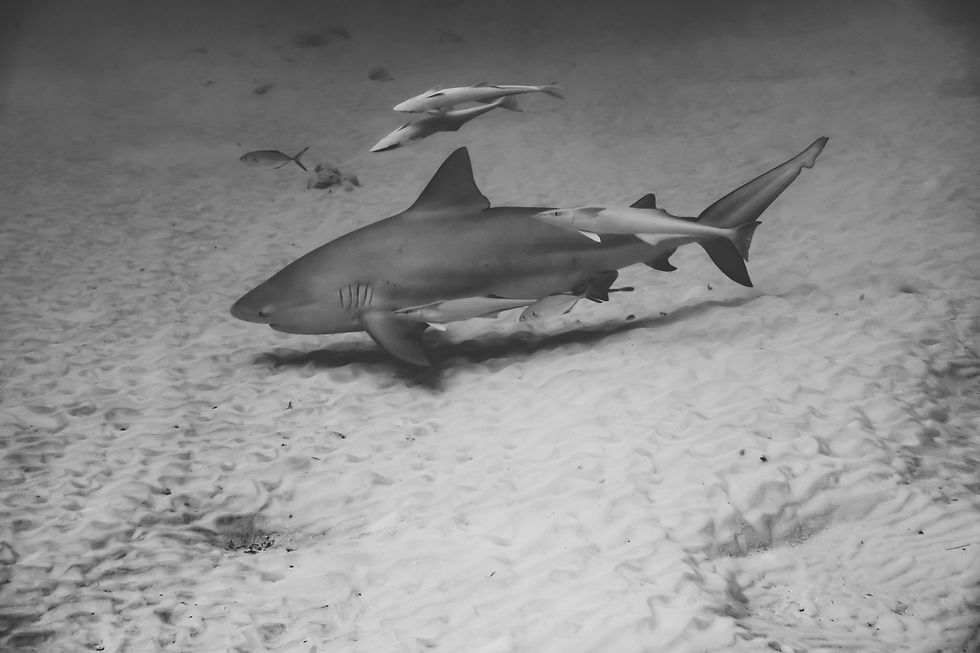
There are operators on this coast who feed bull sharks to pull them in and hold them on a site. We do not, and we do not agree with it.
Everything above happens with no bait, no chum, and no feeder in the water. The sharks are there because that is where they want to be in winter. What you get to watch is the animal behaving normally, which we think is the better experience anyway, and it does not teach a large predator to associate divers with lunch.
The site is coordinated by the National Marine Park of Mexico, which sets the schedules and times. The rules for divers are simple, and we enforce them. No reaching out, no touching, no harassing, no chasing. Stay on the bottom and let them come to you. They will.
Are bull sharks dangerous?

It is the question everybody asks, and it deserves a real answer rather than a marketing one.
Bull sharks have a reputation, and it is not invented. They are big, they are powerful, and they tolerate fresh water, which is why they turn up in rivers and estuaries and end up involved in incidents that most sharks never are.
But look at where those incidents happen. They happen in water where nobody can see anything. Murky river mouths, churned up surf, silty harbors. A shark in that water does not know what it is biting. It investigates with its mouth because it has nothing else to go on.
Playa del Carmen is the opposite of that. On a bad day you have fifty feet of visibility. On a good day you can see two hundred feet without trying. You watch a shark approach from a long way off, and just as importantly, it sees you clearly from a long way off.
That is what changes the encounter. They are drawn in by movement, so they come to look. Once they see what you are, they know you are not food and move away. A few minutes later, curiosity gets the better of them, and they come back for another look. That loop, in and out, is most of the dive.
We have never had an incident on this dive. Not one, in more than twenty years of it operating here.
Who can do it
Open Water certification is the minimum, and it genuinely is the minimum rather than a soft recommendation.
Advanced is not required, but it is a good thing to have because eighty-something feet is deeper than many divers are used to. What matters more than the card is buoyancy control. You need to settle on the sand and stay there without fighting it, and you need a controlled ascent at the end.
That matters most on the Cozumel version of the day, where the shark dive is your third dive. Nitrogen loading is cumulative, and we watch it closely.
One thing worth knowing if you were thinking about training anyway: the bull shark dive can be built into our Advanced Open Water Gold course. If you are going to do the course, you may as well do it in a winter when the sharks are here.
The day, start to finish.

Option one: add the sharks onto your Cozumel day
7:00 AM check-in at the shop, on the road by about 7:15.
Down to Playa del Carmen, onto the fast boat, across to Cozumel.
Two dives on the Cozumel walls, with lunch, snacks and a proper surface interval.
Back on shore at Playa del Carmen between 12:30 and 1:00.
Thirty to forty-five minutes while the crew re-gasses the boat and changes out tanks.
Five minutes back out to the shark site. One tank with the bull sharks.
Back in Cancun around 4:30.
This is added onto the Cozumel Direct 2 Tank day, which runs exactly as it normally does. Worth knowing when you plan the rest of your day: a straight Cozumel trip gets you back to Cancun around 2:00, so adding the sharks adds roughly another 2.5 hours.
Option two: the two-tank Playa del Carmen day
Check in at the shop around 10:30 or 11:00, gear up there, and then we'll drive you down.
One tank with the bull sharks.
One tank on a Playa del Carmen reef.
Back in Cancun in the late afternoon.
Everything is included in both options. Gear, wetsuit, transport down and back, and park fees. Bring money for gratuities, photos, and anything you want to buy. Message us on WhatsApp for the current price on either one.
The one we remember
Ask any of us for our favorite dive, and you will not get a dive site as the answer. It is always the people.
A few seasons ago, a diver from the UK got in touch. He wanted this dive badly. It was not a holiday activity for him; it was something he had wanted for years, a proper life list thing. And we were booked solid.
One of us was off that day and came in anyway to take him. Just the two of them. They drove down together, did the Cozumel dives, came back in, had lunch and sat and talked for a long while.
Then the shark dive turned out to be one of those days. The sharks were everywhere, and they would not leave. Down the line, away, back, down the line again, over and over. Everywhere he looked, a bull shark was cruising past, a meter away and sometimes less. Nothing aggressive, nothing frightening, just an enormous animal going about its business close enough to touch, and nobody touching it.
He was in tears on the way back to shore.
That is the part that keeps us doing this. We see these sharks constantly, and it is routine for us. What is never routine is watching someone go into the water, excited, and come out with real respect for the animal.
Quick Answers
Where are the bull sharks in Cancun?
Off Playa del Carmen, about an hour south of our Cancun shop, less than a kilometer from the beach in around eighty feet of water. We run the trip from Cancun and drive you down.
When is bull shark season in Cancun?
Roughly the first week of November to the middle or end of March, with December and January the peak. Water temperature rather than the calendar drives it, so the edges move year to year. Last season they arrived in October.
How many bull sharks will I see?
Around fifteen on a typical dive, and twenty to twenty-five at the peak of the season. Fewer at the very start and the very end.
Are bull sharks dangerous to divers?
Shark incidents happen in water where nobody can see. Off Playa del Carmen, visibility is fifty feet on a bad day and up to two hundred on a good one, so the sharks see you clearly and know you are not food. We have never had an incident in more than 20 years of operating this dive here.
Do you feed the sharks?
No. No bait, no chum, and no feeder in the water. We do not run feeding tours, and we do not agree with them.
What certification do I need for the bull shark dive?
Open Water is the minimum. Advanced is not required but is useful because the dive is 80 to 86 feet. Good buoyancy control matters more than the card.
How deep and how long is the bull shark dive?
Eighty to eighty-six feet, and about twenty-five to twenty-six minutes before the ascent. It is nitrogen, not air, that ends the dive.
How long does the bull shark day take?
On the Cozumel version, you check in at 7:00 AM and are back in Cancun around 4:30. On the two-tank Playa del Carmen day, you check in around 10:30 or 11:00 and are back in the late afternoon.
What is included?
Gear, wetsuit, transport down and back, and park fees, on both options. There is nothing to pay for on the day, other than gratuities and anything you want to buy. Message us on WhatsApp for the current price.
Diving with us this winter
The season runs November to March, and the best of it is December and January. If you want to go, message us on WhatsApp, and we will honestly tell you what the site is doing that week.
Dive and snorkel with Manta Divers, Cancun.
Call (800) 659-0712 · Info@mantadivers.com · mantadivers.com